
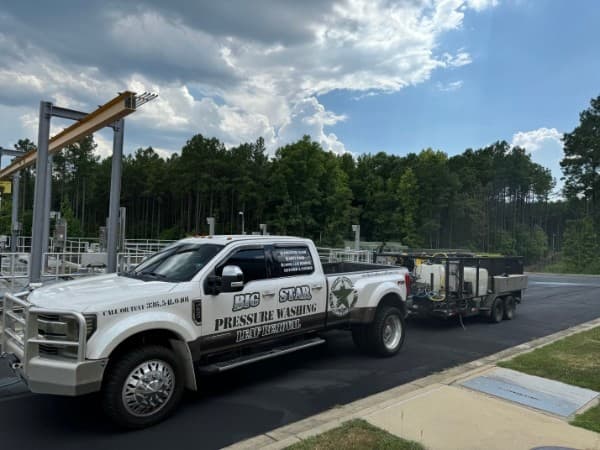
Cleaning a shopping center lot isn't the same job as cleaning a driveway, even though it looks like one. The dirt is different for a start. Grease, tire rubber, fuel drips, dropped food, gum that's been walked flat for a year. The area is ten or twenty times bigger. And most of it has to happen after closing and before opening, which is a short night. Homeowner-grade equipment will get there eventually. It just won't be done by the time the doors open.
Three things that make it a different job
- Heat. Grease and oil don't care how much pressure you throw at them. What breaks them down is temperature.
- Water. A big lot drinks hundreds of gallons an hour, and the closest spigot is usually locked, weak, or on somebody's tenant meter.
- Time. If it doesn't fit in the window between closing and opening, it turns into a second night.
Our trailer rig handles all three, which is most of why we bought it.
What we pull up with
It's a tow-behind hot water pressure washer on a highway-rated trailer. The same class of machine that goes out on jobsite and municipal work, not the kind you rent for a Saturday. The numbers that matter:
- Over 4,100 PSI at 8 GPM, roughly 4x the flow of a homeowner-grade washer
- Water heated to 200°F, hot enough to break grease down instead of pushing it around
- A 550-gallon onboard tank, so the job doesn't depend on finding a working faucet
- A 750cc commercial electronic fuel injected engine that starts cold and holds output for a full shift
- Dual hose reels with over 175 feet each, two high-pressure guns with 4 ft lances, and fifteen quick-connect nozzles
- Adjustable pressure and temperature, set for the surface in front of us
Hot water does most of the work
Cold water moves dirt around. Hot water breaks it down. At 200°F the grease and oil that have soaked into a concrete pad let go instead of smearing, and a spot that takes three or four passes cold will come up in one. On a dumpster pad, a drive-thru lane, or the apron behind a restaurant kitchen, that's the difference between a clean slab and a stain that's only a little lighter than it was.
Heat also means we don't have to lean on pressure as hard. When the temperature is doing the work, we're not standing there with the trigger wide open, etching the concrete to get a result out of it.
550 gallons means we don't need your water
This is the one property managers don't think about until it comes up. Carrying our own water means we're not asking anybody for a hose bib, not running two hundred feet of garden hose across a public sidewalk, and not putting the wash on a tenant's meter. It also means we can clean sites with no usable water at all. Back lots, gated pads, a building mid-renovation with the service shut off.
We refill off site between runs. Your building doesn't have to be open, or even occupied, for us to work on it.
Two wands, half the night
A commercial lot isn't a bigger driveway. It's the same work with the store opening at six.
The trailer runs two hose reels off the one machine. A single gun gets the full 8 GPM when we need everything it has. Split across both, it's 4 GPM each, which is still more than most crews show up with on one wand. Two of us working opposite ends of a lot cuts the night roughly in half, and the night is usually what we're quoting against.
What we put it on
- Dumpster pads, corrals and the concrete around them
- Drive-thru lanes, fuel islands and canopy columns
- Loading docks, service bays and equipment yards
- Storefront sidewalks, entries and covered walkways
- Parking lots and parking decks
- Restaurant back-of-house pads and grease-trap surrounds
- Apartment and HOA breezeways, stairwells and mail areas
- Fleet vehicles, heavy equipment and post-construction cleanup
Scheduling, and where the water goes
Commercial work runs on your hours, not ours. Most of it happens overnight or first thing in the morning, before staff show up and while the lot is empty enough to actually clean. We walk the site ahead of the night we're booked, find the drains, and agree where the wash water is going before the trailer comes off the hitch. Plenty of municipalities and lease agreements have rules about what can go down a storm drain, and 2am is a bad time to find that out.
If the job has been sitting
If you manage a property around the Triad and you've been putting off the pad, the lane, or the whole lot because it looks like too much, it probably is too much for a homeowner rig. It's a normal night for this one. Estimates are free and on site. We walk the property, work out how many hours it really takes, and give you a fixed number before anything gets wet. Most of this falls under pressure washing and concrete cleaning, and if the building needs doing too, that's a full-property wash — though the building envelope itself wants soft washing rather than more pressure.